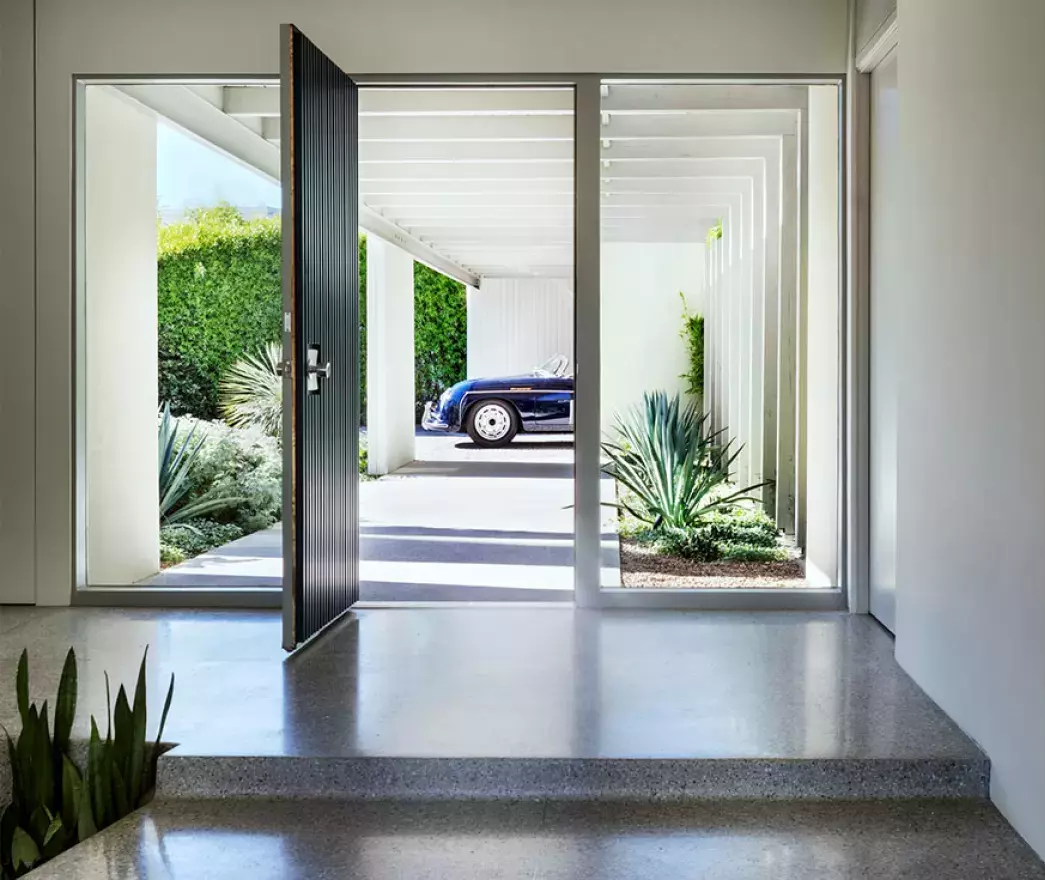
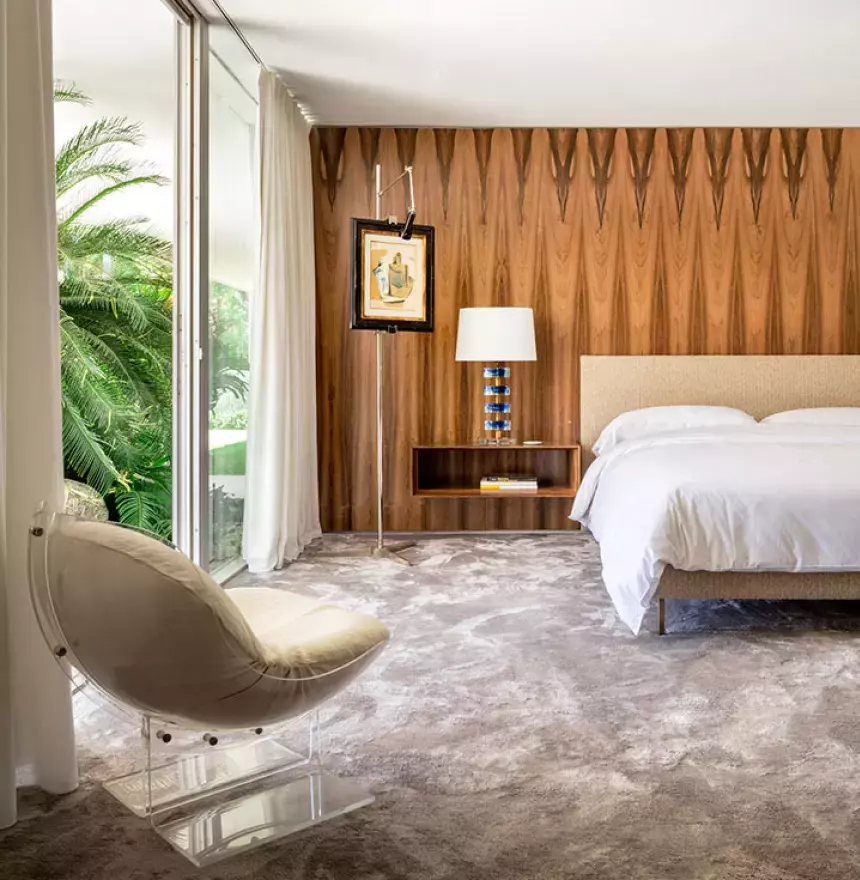
The Palm Springs residence, originally designed by Donald Wexler, is an essay in minimalist architecture—a home that communicates through precision, restraint, and clarity of form. Rather than layering on new design statements, Steven Harris Architects chose to pare down, refine, and preserve. The result is not a reinvention, but a quiet dialogue between past and present.
Once known as the Charney House, the property already possessed an almost grammatical order: lines aligned with intention, spaces unfolding in careful syntax. Harris recalls discovering the home almost by accident, only to be captivated by its purity. For him, the challenge was never about leaving his own mark but about ensuring that the house continued to speak in Wexler’s voice. Almost all of the original fabric remains intact, honoring the rigor of its first conception.
Inside, the layout stays true to a minimalist ideal—rooms are few but purposeful. A single bedroom, a living space, and a dining room extend diagonally across the plan, emphasizing flow over division. The kitchen recedes quietly behind a wooden partition, its presence felt rather than declared. Every transition is deliberate, stripping the idea of “home” down to its essential gestures.
Approaching through a covered entry and terrazzo walkway, the sequence of views is choreographed: the pool, the golf course, palm trees, and finally the mountains. These framed vistas extend the minimalist philosophy outward, showing how architecture can strip away the unnecessary until landscape itself becomes the ornament.